After working with top Web3 projects, we know which strategies drive real visibility and growth, and how to execute them.
View Our Case Studies
After working with top Web3 projects, we know which strategies drive real visibility and growth, and how to execute them.
View Our Case Studies 2026 is the year crypto projects are going bigger: AI agents, RWAs, data layers, and intent-based UX are reshaping the space and raising the bar for everyone.
The ecosystem is expanding, expectations are higher and attention is harder to earn. With mass adoption around the corner and institutions entering the mix, success in 2026 takes smarter narratives, tighter execution and strategy that actually sticks.
We’ve worked with over 300 Web3 projects, and we’ve seen what actually works.
So we’re laying itф out for you now.
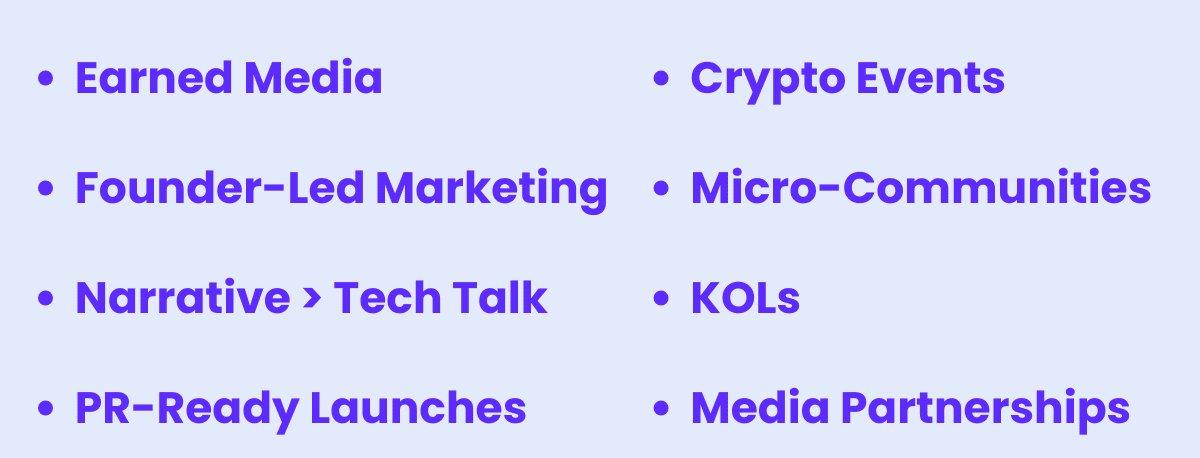
Here are 8 strategies still driving results in 2026, and 3 you can leave behind.
8 Strategies That Still Work
Earned Media Builds Authority
Top-tier press coverage in trusted crypto and tech publications drives credibility that paid ads can’t replicate. Whether it’s a Forbes exclusive or a CoinDesk mention, each feature acts as a trust signal that compounds over time.
Why it matters: Media coverage acts like third-party social proof for your brand. Audiences trust articles and interviews more than direct marketing.
Pro tip: Pair media outreach with conference appearances to build real relationships with journalists, and feature follow-up interviews across podcasts and YouTube. Use screenshots, follower counts, or engagement stats to prove reach.
We work directly with founders, exchanges and protocols to shape earned media strategies. From securing interviews and coverage in top publications, like Bloomberg, Reuters, NYT, to placing clients on the main stage at Token2049, Paris Blockchain Week and Korea Blockchain Week, we create visibility that drives real outcomes across fundraising, partnerships and growth.
Founder-Led Marketing
Founders who lead the conversation on X, LinkedIn and live spaces create a personal brand that outlasts token cycles. People trust people (especially in crypto).
Why it matters: A founder’s voice humanizes the project. This is especially valuable in high-stakes launches.
Pro tip: Help founders draft opinionated posts, join panels and engage thoughtfully on X. It builds long-term brand equity.
Narrative > Tech Talk
Your tech won’t matter if you don’t explain what it solves. Crafting a compelling narrative around your vision and mission wins more minds than a bullet-pointed roadmap ever will.
Why it matters: Investors and users need a reason to care. A strong “why now?” and “why us?” drives engagement.
For instance, when DWF Labs invested $25M into World Liberty Financial, the impact came from a narrative crafted around the news itself. We helped strategically pitch and shape the story to highlight DWF’s role as “Liquidity Architects”, bridging institutional finance and DeFi.
Rather than centering technical details, the story was built around timing, positioning, and market relevance. This resulted in top-tier coverage across both mainstream and crypto publications, reinforcing DWF’s growing influence in the U.S. expansion race.
PR-Ready Teams Win Launches
No one really cares about another launch. They care about the meaning behind it: what it signals, what it solves and why it matters now.
Projects that prepare messaging, visuals, FAQs and storylines in advance dominate headlines.
Why it matters: A launch is a spotlight, but only for a moment. You have a narrow window to grab attention, build momentum and start shaping perception.
Pro tip: Treat launches like product drops: coordinate media, prepare the founder’s talking points and sync with community managers across platforms.
For example, when Polygon launched its mainnet and staking program, we helped secure 25+ earned media mentions in the surrounding weeks, turning the launch into a momentum engine. This resulted with over 50% of all tokens were staked in the first month, alongside a noticeable uptick in interest from investors, partners and ecosystem developers.
Events are Everything
Crypto Events are high-impact when you show up with a strategy. The real winners come ready to connect, lead conversations, and make it count.
Why it matters: Real-world trust is forged face-to-face. Events amplify everything else: media, partnerships and user trust.
Pro tip: Lock in media interviews in advance, plan side events and use earned moments to feed your social and content engine in real time.
If you want to know further how to win at crypto events, click here.
Micro-Communities Have Macro Impact
Web3 audiences are all over:Telegram, X, Discord, Reddit and much more. Each platform has its own tone, culture and pace. Smart brands adapt and speak each platform’s language.
Why it matters: While reposting the same content everywhere feels tone-deaf, personalized messaging drives deeper engagement.
Pro tip: Use each channel’s native tools: polls on Telegram, memes on X, AMAs on Discord, deep dives on Reddit. One size doesn’t fit all.
For example, when the EOS Network Foundation broke away from its former leadership, its challenge wasn’t just rebranding, it was rebuilding trust across a fractured ecosystem. We shaped tailored messaging for each community platform, from in-depth AMAs on Discord to candid interviews on YouTube and Reddit threads clarifying the new roadmap. Combined with a strong media push (Wired, Nasdaq, Entrepreneur), the effort repositioned EOS as a decentralized project run for and by the community.
KOL’s
Love them or hate them, Key Opinion Leaders still hold massive sway in Web3. But reach isn’t all they get. The smartest projects treat KOLs as partners rather than promoters. That means working with voices who genuinely understand your product, speak the language of their audience, and add genuine credibility.
Why it matters: One authentic and consistent KOL who believes in your mission will drive more impact than ten who are just reading off a script.
Media Partnerships
If you’re trying to get seen in a crowded market, aligning with the right conference or ecosystem can do a lot of heavy lifting. Being a media partner opens doors: it puts you in the room, gives you a reason to be part of the conversation and enables access that cold outreach never will.
Why it matters: they build momentum. People notice who’s visible, who’s included, and who’s shaping the conversation.
3 Strategies That Don’t Work
Global “Copy-Paste” Campaigns
Asia ≠ U.S. ≠ Europe. Every region has its own unique cultural tone, platforms and user psychology.
Why it fails: Launching the same campaign everywhere dilutes your message and shows you don’t get the market.
Pro tip: Build region-specific messaging, partner with local KOLs, and time launches around regional dynamics.
Planning on Going global? Read our globalization playbook here.
Posting Just to Post
Consistency is great, but random content isn’t a strategy.
Just posting to “stay active” won’t build trust, authority or connection.
Why it fails: Your audience can tell when you’re just filling space. Even memes, humor, or updates should tie into a bigger message.
Pro tip: Post with intention. Every piece of content (even the light stuff) should serve a purpose: clarify your vision, strengthen your narrative, or connect with your people.
Bots & Fake Followers
You might impress a VC on a bad day, but the community will spot it instantly. Authenticity is the currency.
Why it fails: Buying fake numbers damages trust. Real growth comes from organic connection.
Pro tip: Focus on quality engagement over vanity metrics. Long-term brand equity matters more than follower counts.
The bottom line is that Web3 has matured, and your marketing should too. The winners in 2026 will be the ones who invest in true strategy and storytelling.
At MarketAcross, we build strategies that survive the bear and thrive in the bull. From founder amplification to full-stack launches, we’ve helped the biggest names in Web3 earn trust at scale.
Want to stay relevant in 2026 and beyond? Let’s talk.

After working with top Web3 projects, we know which strategies drive real visibility and growth, and how to execute them.
View Our Case Studies